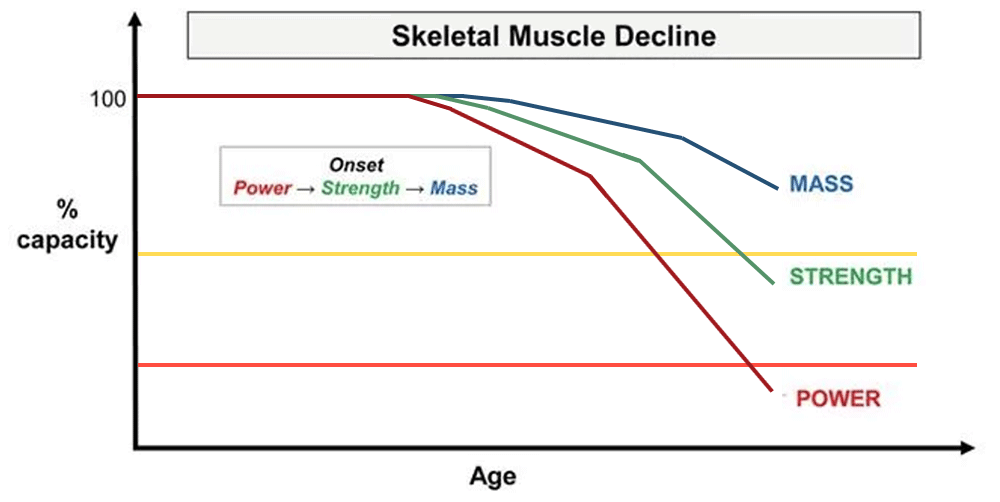
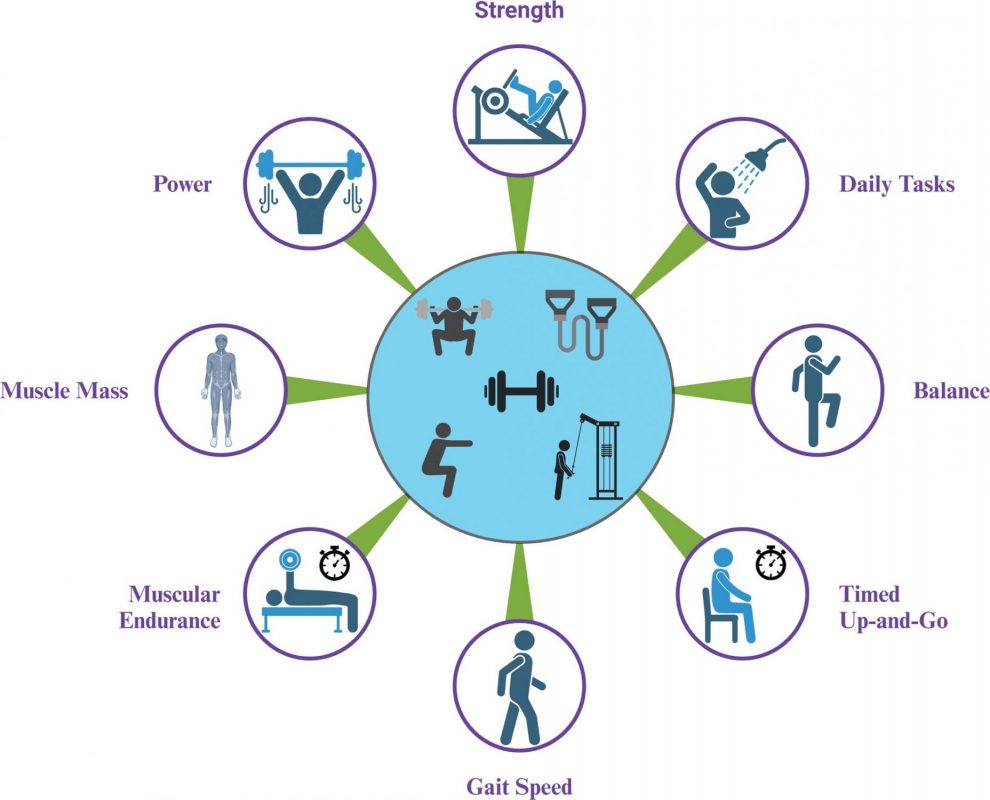
SUMMARY: The most effective strategy to combat physical aging is to bring some intensity &…

LET’S TALK ABOUT THE U.S. PHYSICAL ACTIVITY GUIDELINES
SUMMARY: Many older adults (OAs) are unaware of the Physical Activity Guidelines for Americans (Guidelines) and roughly 75% of Americans fail to meet the full Key Guidelines. The full 118-page Guidelines document “is designed to provide information and guidance on the types and amounts of physical activity that provide substantial health benefits” and, indeed, the Guidelines are full of useful information toward meeting this goal – and it’s free for everyone to access, download and read. In this post, I discuss the origins of the Guidelines document as well as the specific Key Guidelines for OAs. I also discuss the specifics of how physical activity (PA) intensities (the physical challenge) are defined, characterized and used within the Guidelines and offer specific tips for OAs to determine PA intensity to implement the Key Guidelines effectively. I delve into the “health equivalence” of light, moderate & vigorous intensity PA and I consider how intensity-free strategies for PA like “step counts” might be sub-optimal to affect the best positive health outcomes.
INTRO
Many older adults (OAs) are unaware of the Physical Activity Guidelines for Americans (Guidelines) published by the U.S. Department of Health & Human Services (HHS). And meeting the Guidelines is another nut to crack: taking all adult age groups into consideration, only 26% of men & 19% of women meet the full Guidelines for aerobic & resistance exercise (page 15 of Guidelines).
The Guidelines document says it “is designed to provide information and guidance on the types and amounts of physical activity that provide substantial health benefits”. And “the main idea behind the Guidelines is that regular physical activity (PA) over months and years can produce long-term health benefits”, so the goal of meeting the guidelines is to optimize those referenced health benefits.
When discussing the Guidelines, I also want to focus on the specifics of how PA intensities (the physical challenge) are defined, characterized and used within the Guidelines, as these considerations are very relevant to my post for next month. In particular, I want to point out how the Guidelines weigh the “health equivalence” of light, moderate & vigorous intensity PA to affect positive health outcomes and reduce mortality risks.
When discussing PA intensity, it’s really important to emphasize that vigorous intensity PA is perhaps not as vigorously intense as we might imagine. It’s challenging for sure, but it’s not even close to all-out effort; rather it’s an intensity level that many OAs can accomplish & sustain regularly (particularly with some graded & gradual intensity preparation over time).
PRODUCING THE PA GUIDELINES FOR AMERICANS
The first Guidelines was published in 2008 and the most recent Guidelines (2nd Edition) dates from 2018. The 2nd Edition is an amazing document as it contains lots of quality information AND it’s free for everyone to access, download and read – so I encourage you to take a look at it!
The process of producing the Guidelines starts with the HHS secretary appointing an external scientific advisory committee of multi-disciplinary scientists. This committee conducts a series of systematic reviews of the PA & health scientific literature (1) and meets periodically to discuss their findings. The committee’s work is next compiled into a scientific report summarizing the then-current evidence called the 2018 PA Guidelines Advisory Committee Scientific Report.
The 2018, 2nd Edition Guidelines document was written by HHS using the Advisory Committee Scientific Report, as well as comments from the public and other government agencies. The Guidelines document consists of eight chapters and two appendixes and covers 118 pages (2).
The Guidelines document says it’s written for “policy makers and health professionals”, but “this information may be useful to interested members of the public”. I would say most anyone can read & understand its contents – particularly if you consult the glossary on pages 104 to 107.
Note, however, there is additional supporting information for the general public: the office of Disease Prevention & Health Promotion within HHS created the Move Your Way website as a resource to translate actionable information from the Guidelines for the consumer.
THE KEY PA GUIDELINES FOR OLDER ADULTS
Within the Guidelines document, OAs are charged with following two categories of Key Guidelines:
1) Key Guidelines for Adults – see below and page 55 of Guidelines
2) Key Guidelines for Older Adults – see below and page 66 of Guidelines
In addition, some OAs will want to consult the following Key Guidelines and information:
3) Additional Considerations for Some Adults (page 78)
4) Key Guidelines for Safe Physical Activity (page 87).
Key Guidelines for Adults (18 to 64 years)
• Adults should move more and sit less throughout the day. Some physical activity is better than none. Adults who sit less and do any amount of moderate-to-vigorous physical activity gain some health benefits.
• For substantial health benefits, adults should do at least 150 minutes (2 hours and 30 minutes) to 300 minutes (5 hours) a week of moderate-intensity, or 75 minutes (1 hour and 15 minutes) to 150 minutes (2 hours and 30 minutes) a week of vigorous-intensity aerobic physical activity, or an equivalent combination of moderate- and vigorous-intensity aerobic activity. Preferably, aerobic activity should be spread throughout the week.
• Additional health benefits are gained by engaging in physical activity beyond the equivalent of 300 minutes (5 hours) of moderate-intensity physical activity a week. • Adults should also do muscle-strengthening activities of moderate or greater intensity and that involve all major muscle groups on 2 or more days a week, as these activities provide additional health benefits.
Key Guidelines for Older Adults (65+)
The key guidelines for adults also apply to older adults. In addition, the following key guidelines are just for older adults:
• As part of their weekly physical activity, older adults should do multicomponent physical activity that includes balance training as well as aerobic and muscle-strengthening activities.
• Older adults should determine their level of effort for physical activity relative to their level of fitness.
• Older adults with chronic conditions should understand whether and how their conditions affect their ability to do regular physical activity safely.
• When older adults cannot do 150 minutes of moderate-intensity aerobic activity a week because of chronic conditions, they should be as physically active as their abilities and conditions allow.
*Additional Supportive Material From My Previous Blog Posts To Help Meet the Guidelines *
1) See here for what I consider the most important type of balance training for OAs
2) See here for how to measure intensity with muscle-strengthening (resistance) exercise
3) See here for tips on one of the most important resistance exercises for OAs
4) See here for how to measure relative intensity for cardio (aerobic) exercise
INTENSITY OF PHYSICAL ACTIVITY AND THE GUIDELINES
PA intensity (effort level) can be expressed in: a) absolute terms based on energy expenditure; or b) relative terms based on an individual’s level of fitness and their perceived effort (this is relevant to OAs – see below)
The Guidelines primarily determine the PA intensity by how much energy is expended performing a particular activity, and then stratifies absolute intensity levels into: 1) light; 2) moderate; and 3) vigorous.
PA energy expenditure is expressed in multiples of METs (metabolic equivalent of task) where 1 MET is the amount of energy expended at rest. So, a 5 MET activity expends 5x the amount of energy as resting level.
*Light intensity PA is defined as greater than 1.5 METs to less than 3 METs. Examples might include slow walking (2 mph or less) or light household chores or cooking activities.
*Moderate intensity PA is considered 3 METs to less than 6 METs. Examples might include walking briskly (2.5 to 4 mph) or raking leaves in the yard.
*Vigorous intensity PA is 6 METs or more. For example, slow jogging at 4.5-5.5 mph is 6-8 METs, while transitioning to running at 6 mph (10 minute per mile pace) is 10 METs. Other examples might include carrying climbing stairs at a brisk pace or carrying loads while climbing stairs.
For OAs what’s important is the Guidelines encourage using relative intensity – relative to you & your personal level of fitness – to manage & determine effort level during PA. This is because many OAs have a low level of fitness, so may find absolute intensities for moderate or vigorous PA beyond their current physical capabilities.
For OAs, using relative intensity means using something like the 10-point Modified Borg Perceived Exertion Scale (RPE), which I’ve covered extensively in a previous post, so check that post out.
So, for OAs, according to the Guidelines:
A) Perceived effort below 5/10 RPE would be considered “light” PA
B) Perceived effort at 5-6/10 RPE would be considered “moderate” PA
C) Perceived effort at 7-8/10 RPE would be considered “vigorous” PA
HEALTH EQUIVALENCE OF PHYSICAL ACTIVITY INTENSITIES
Note the Key Guidelines don’t consider light intensity PA as producing positive health outcomes and do not explicitly recommend them – in fact, the first Key Guideline for Adults says this: “do any amount of moderate-to-vigorous physical activity (to) gain some health benefits”.
Note, also, in terms of efficacy, the Key Guidelines weigh 2 minutes of moderate intensity PA to be equal to 1 minute of vigorous intensity PA for producing positive health outcomes. This is what I mean by “health equivalence” – vigorous intensity is considered to be twice as effective per minute of PA as moderate intensity, and light intensity PA isn’t even on this “health equivalence” scale in the Key Guidelines.
I bring these “health equivalence” concepts to your attention because in my next post, I’m covering a new study that seems to show vigorous intensity PA has an outsized impact on health & mortality risk reduction. In this study vigorous PA is not 2x as effective as moderate intensity PA, but more like 10x as effective, depending on the positive health outcome considered, so it’s possible the Guidelines vastly underestimate the health benefits of vigorous PA. Stay tuned…
WHERE DOES “GETTING YOUR DAILY STEPS” FIT IN?
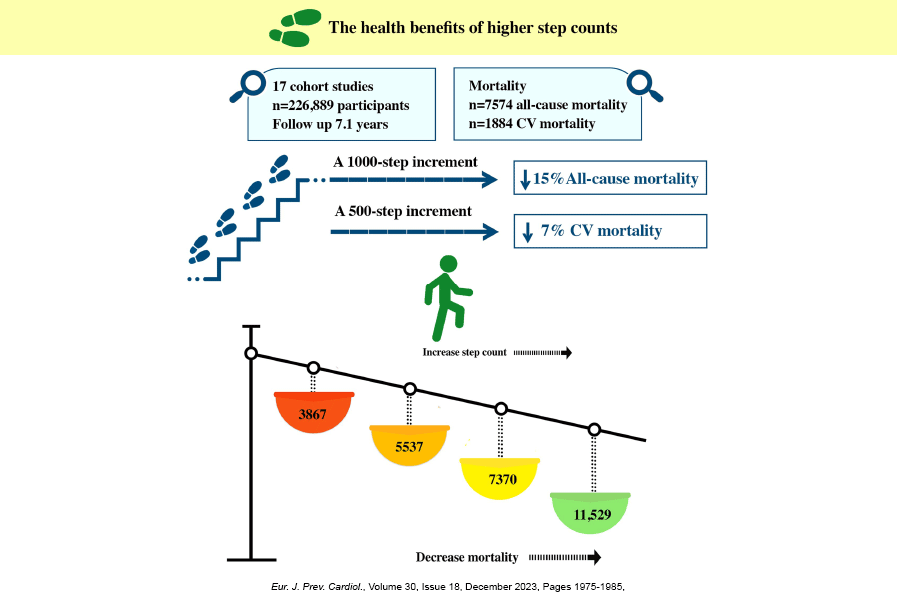
Your can read Appendix 1 on page 108, but my main take is this: counting daily or cumulative steps without any consideration of the intensity of those steps is a sub-optimal strategy for producing the best positive health outcomes – if you’re medically & physically able, you should try for at least moderate intensity (5/10 RPE).
There is a body of scientific research that shows positive associations with the number of daily steps and all-cause mortality. I’m not a researcher, but I’d say the reasons for this are at least two-fold: 1) a reasonable number of daily steps moves you out of the “sedentary” category which is health enhancing; and 2) perhaps some portion of the steps subjects performed in step-count studies are performed at moderate intensity even if this is not captured or considered or quantified in the step-count studies.
Footnotes:
(1) Systematic Review Information
(2) The Guidelines Table of Contents:
Physical Activity Guidelines for Americans Summary – Page 6
A Roadmap to the Physical Activity Guidelines for Americans – Page 12
Chapter 1. Introducing the Physical Activity Guidelines for Americans – Page 13
Chapter 2. Physical Activity and Health – Page 27
Chapter 3. Active Children and Adolescents – Page 46
Chapter 4. Active Adults – Page 55
Chapter 5. Active Older Adults – Page 66
Chapter 6. Additional Considerations for Some Adults – Page 78
Chapter 7. Active and Safe – Page 87
Chapter 8. Taking Action: Increasing Physical Activity Levels of Americans – Page 94
Glossary – Page 104
Appendix 1. Physical Activity Behaviors: Intensity, Bouts, and Steps – Page 108
Appendix 2. Federal Physical Activity Resources – Page 113
U.S. Department of Health and Human Services. Physical Activity Guidelines for Americans, 2nd edition. Washington, DC: U.S. Department of Health and Human Services; 2018.

Related Posts