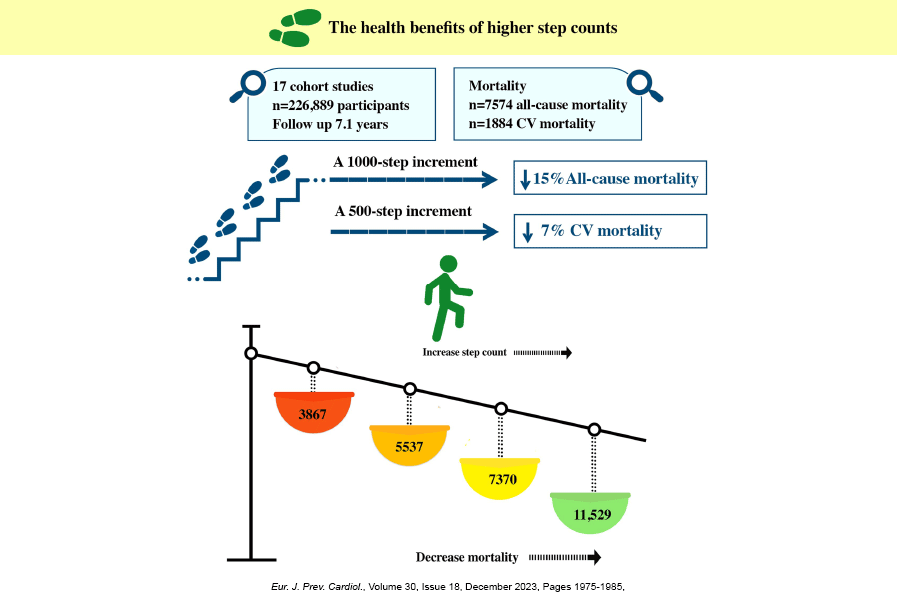
Summary: Walking is very important for older adults (OAs) and that's why this is my…
THE OUTSIZED RETURN ON INVESTMENT OF VIGOROUS PHYSICAL ACTIVITY
SUMMARY: Here is a study that uses wrist-worn accelerometer data to break new ground with intensity-comparing physical activity (PA) data collected on older adults (OAs). The study presents findings which suggest the health/mortality risk reduction “return on investment” is 400% to 900% greater for vigorous-intensity PA compared to moderate-intensity PA, and moreover, that light-intensity PA is 5300% to 15,600% less effective than vigorous-intensity PA. At the individual level, all PA intensity classifications matter because we all have different current capabilities, goals, and physical constraints. But this study, my VILPA-study January post, the accumulation of favorable findings from high intensity interval training studies, and the current emphasis for resistance training for OAs, all add to a growing emphasis that for optimal aging and health risk reduction, we may need to move away from PA time-based metrics (accumulate minutes or step counts) in favor of intensity-based metrics like the 10-point relative perceived exertion scale and/or mindful & purposeful effort for movements and activities of daily living.
INTRO
The recently published study discussed below is extremely interesting as it captures novel, important and useful physical activity (PA) health outcomes information. The study has the same authors, used the same cohort of subjects, and the same method to collect PA data as the study I covered in my VILPA-study January post, so I’d recommend you read that first.
Also, some good background is last month’s post where I discuss the Physical Activity Guidelines for Americans (Guidelines), which emphasize that for preventing death & disease, vigorous intensity PA (VPA) is twice as effective on a per-unit-time basis as moderate intensity PA (MPA). Specifically, 1 minute of VPA is equal to 2 minutes of MPA in the Guidelines and I discussed the basis for this 1:2 ratio for “health equivalence”.
It’s the comparison of the “health equivalence” or “health return” of light intensity PA (LPA), MPA, and VPA which is the main outcome highlighted in the present study, and the main point is the findings show an outsized “health equivalence” spread between VIPA & MIPA than the Guidelines suggest. Indeed, this study’s findings suggests the health & mortality risk reduction “return on investment” is 400% to 900% greater for VPA compared to MPA, and completely off the charts when comparing LPA to VPA.
THE STUDY
This study was published in Nature Communications in October, 2025. It was performed by Emmanuel Stamatakis’s group at the University of Sydney, Australia. The study used wearable device technology to track and stratify the intensity & amount of daily PA. I describe the methods used in my VILPA-study February post, but I’ll emphasize this technology allows for the capture of total PA, not just structured exercise sessions as is traditional for this kind of research.
There were 73,485 subjects (56% female) from the UK Biobank cohort. Average age was 62, so these were mostly older adults (OAs). They were followed for 8 years to capture the main outcomes:
1) All-cause mortality (ACM)
2) cardiovascular disease mortality (CVD)
3) major adverse cardiovascular events (MACE)
4) type 2 diabetes
5) deaths from PA-related cancer
Some subjects were excluded and a multitude of variables were statistically adjusted to prevent reverse causation bias and/or confounding influences (outcome distortion) from factors that might affect death or health outcomes or influence the amount or intensity of PA.
This study compared the risk reduction between LPA & MPA to VPA for a standardized 5-35% risk reduction for the health & mortality outcomes listed above. In other words, the question being asked was: starting with the effect of 1 minute of VPA as the comparator baseline, how many minutes of MPA or LPA would it take to elicit the same standardized risk reduction?
Notable Findings:
*Graphical representations of the notable findings are here and here*
1) For a similar risk reduction, 1 minute of VPA was equivalent to about 4-9 minutes of MPA, depending on which above-listed outcome – so VPA was 400-900% more effective.
2) For a similar risk reduction, 1 minute of VPA was equivalent to about 53-156 minutes of LPA, depending on which above-listed outcome – so to elicit the same effect as 1 MINUTE of VPA, 1 to 2.5 HOURS of LPA would be required.
3) VPA had a pronounced nearly linear dose-response effect – meaning the more VPA accumulated the greater the risk reduction.
4) MPA had a moderate dose-response effect up to a point
6) LPA had a poor dose-response effect – there was a 15% risk reduction ceiling – meaning not even the largest amounts of LPA elicited the beneficial effects of VPA & MPA.
COMMENTS
This study is not perfect, but it is important because it’s a first-of-its-kind study: The comparison of the “health equivalence” of VPA, MPA, and LPA has never been done before. Moreover, capturing total PA (including activities of daily living), along with the traditional & standard structured exercise is also a first to my knowledge.
If you’ve been following my “Importance of Hard Things” posts, you know I’ve been presenting the scientific evidence for the importance of some “higher” intensity PA for OAs to age optimally, and this study adds to the evidence that VPA has an outsized “return on health investment” compared to MPA or LPA for important health and mortality outcomes.
At the individual level, and particularly for OAs, all intensity classifications of PA matter because we all have different current capabilities, goals, and physical constraints – enough LPA moves you out of the sedentary category which is important, and MPA is quite doable for most OAs and can be a stepping stone (physical & mental preparation) for VPA to make it safer, more tolerable and achievable.
This study has been criticized by some, but effusively praised by others. A limitation is the PA data was only collected for a week at the beginning of the follow up period. Wrist-worn accelerometer devices capture how often and how fast someone moves their arm, but not the muscle contraction intensity or what the legs are doing. However, I did dig into this factor and it seems the authors bent over backwards to use an apparent three-step process to “validate (their data) against established measures of PA energy expenditure”.
And it should be stressed that when we’re referring to VPA, we’re not talking about all-out intensity PA – here on page 5 is text & a schematic diagram of the wearable device-based PA classifications – “mg” stands for “milligravity” a unit of acceleration.
Lastly, this study is part of an ongoing trend supporting the notion that, for optimal aging and health-risk reduction, we may be moving away from time-based metrics (accumulate time or step counts) and moving toward more intensity-based metrics for PA (1) like the 10-point relative perceived exertion scale and/or mindful & purposeful effort for movements and activities of daily living, so as I’ve been saying now for several posts:
If you are medically, orthopedically and energetically able, it pays off to challenge yourself regularly with some intensity, even if it’s just done in very short bursts of activity at a time.
Footnotes:
(1) Sometimes or even often, there is a paternalistic attitude that we need to make health, nutrition & exercise recommendations based on what people will do, rather that what is best. I believe people should have access to all the information and make their own informed choices about their lifestyle.

Related Posts