SUMMARY: Previously, I’ve discussed many exercise & physical activity strategies to help older adults (OAs)…
THE IMPORTANCE OF DOING FAST THINGS: EDITION #2
SUMMARY: Last post, I covered a study which showed that the ability to express muscular power was 600% to 700% more effective at reducing mortality risk in older adults (OAs) than the ability to express strength. To help answer the question as to why power might be so important to minimize risk of death, I’m following up with an exciting & ambitious study in which OA participants trained for power (PT) 3x/wk for 16 weeks using elastic band or water resistance. Outcome measures included biomarkers of cognitive health & neuroplasticity, oxidative defenses & systemic inflammation, as well as standard tests of strength, physical function, and perceived health-related quality of life. Both PT modalities significantly improved most, if not all, outcome measures. So, we have additional info layered on to last post’s study to help explain why OAs with greater power expression have such a striking decrease in their risk of death – the power-trained OAs in the present study improved functional ability as predicted, but also improved their internal physiologic milieu in ways that were more conducive to better health, better cognitive functioning, better aging, and less risk of the chronic diseases of aging. To better understand the present study and it’s significance, I also touch on the pleiotropic effects of exercise, the 12 Hallmarks of Aging, Inflammaging in OAs, sarcopenia in OAs, and the compound creatine.
INTRO
Last post I covered a study which assessed which neuromuscular quality – strength or power – was more effective in predicting older adults (OAs) risk of death. The results were one-sided: greater power was associated with a 600% to 700% mortality risk reduction when compared to strength.
But why? Well, I discussed power’s outsized positive influence on how our neuromuscular system might function in response to the demands of life as we age, but there’s more to it, and that’s the topic of this post.
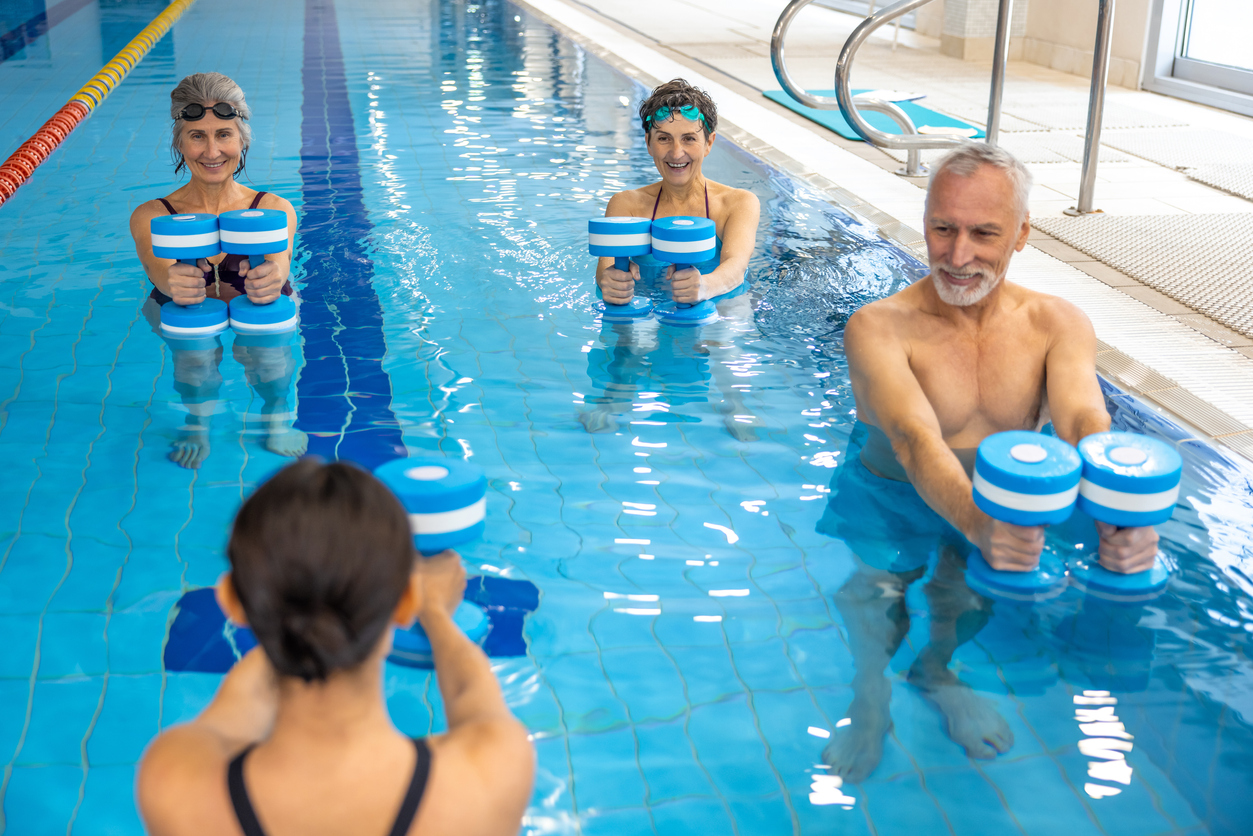
The study presented below is an exciting and very ambitious study which attempted to cover a lot of ground about power training’s (1) ability to positively influence a host of physical, physiological and cognitive aspects of aging. It is a randomized, double blind, placebo-controlled trial (RCT) of OA participants who power-trained (PT) 3x/week using: 1) elastic band resistance; or 2) pool water resistance; and 3) with or without creatine supplementation.
To understand why the study authors measured so many outcomes, it is helpful to consider the term pleiotropic, from the Greek words “pleion” (more) and “tropos” (turn or way), it means producing more than one effect – and that’s really the essence of exercise in general, and resistance exercise (RE) in particular. Exercise challenges our muscles, which then release “myokines” which are signaling proteins that “cross-talk” with our genes, molecules, and organ systems throughout the body. This is a big reason why exercise is such an effective and comprehensive “anti-aging” tool.
Before detailing the study, let’s briefly touch on some concepts about the actual mechanisms of aging, the physiological/biological milieu of aging, the condition of sarcopenia in OAs, and the compound/supplement creatine.
THE TWELVE HALLMARKS OF AGING
First proposed in 2013, and updated & expanded in 2023, the hallmarks of aging (hallmarks) are cellular & molecular changes which drive the physical/physiological declines of aging – they are the mechanistic pathways of aging.
Aging is driven by molecular, cellular, and physiological damage or negative alterations. A hallmark fulfills three criteria: 1) it’s function declines/worsens with age; 2) biological aging accelerates if you experimentally increase it; and 3) if you experimentally/therapeutically stop or slow it down, it has a positive effect on the aging process or otherwise extends lifespan.
There are currently 12 hallmarks which interconnect and synergize/reenforce each other to create the steady stream of aging’s dysfunctions, diseases, and physical limitations. The hallmarks are: genomic instability, telomere attrition, epigenetic alterations, loss of proteostasis, disabled macroautophagy, deregulated nutrient-sensing, mitochondrial dysfunction, cellular senescence, stem cell exhaustion, altered intercellular communication, and dysbiosis (see the helpful graphic in 2023 the paper).
Although you might consider presentation of these hallmarks as overly technical, they are an important piece of what causes the physical/physiological/cognitive decline with aging, as well as the chronic diseases of aging, so it’s good to at least be aware of them. For each individual hallmark, I’ve linked to a Google search with an AI summary. Additionally, Dr. Michael Greger, in his book How Not to Age, covers each hallmark in detail, as well as ways to mitigate them. Dr. Eric Topol, in his book Super Agers, also explains each hallmark well. Both books are worth the read – after-all, if you’re interested in aging well, it pays to understand what aging is, and what current thinking & studies say we can do about it.
Key Point: One of the most effective ways to positively impact many of the hallmarks is regular exercise and physical activity!
INFLAMMAGING
The hallmarks collectively cause more oxidative stress (2) which in turn promotes further deterioration of the hallmarks, particularly for our purposes, the chronic inflammation of aging, which is termed inflammaging.
Inflammaging is linked to most of the chronic diseases of aging, and again, exercise is one of the best ways to fight it, as you will see how that plays out in the study below.
The amount of chronic inflammation is measured by C-reactive protein, and inflammatory cytokines like interleukin-6 (IL-6) and tumor necrosis factor-alpha (TNF). You may be familiar with the “cytokine storm” of Covid or influenza, which exacerbates negative complications, disability or death; the cytokine storm is the reason you’re 6x more likely to have a heart attack during the flu – a fact not widely known by the general public.
SARCOPENIA
As discussed in my last post, sarcopenia is the age & disuse associated loss of muscle mass, strength and physical function driven mechanistically by the hallmarks. And, as I emphasized last post, loss of physical function is perhaps the most important component of sarcopenia from the standpoint of aging well, staying independent and avoiding death.
Sarcopenia is best addressed with resistance exercise/training (RE). RE which emphasizes power (1) seems to have a much greater positive effect on physical function than conventional RE. And, PT also has the potential to improve some strength expression as well, as we’ll see below.
CREATINE
Creatine is a compound made in the liver, kidneys and pancreas from three amino acids (building blocks of protein). It is contained in meat & seafood, so people who don’t eat meat/seafood may have more potential to respond positively to creatine supplementation. Most of the creatine in our bodies is found in muscle (95%). It is important for producing our universal energy currency, ATP, and might have an ability to somewhat decrease inflammation & oxidative stress.
Creatine was discovered almost 200 years ago, is very well studied, and is generally safe to consume as a supplement (unless you have kidney disease). The standard well-studied dose is 3-5 grams/day or 0.1 gram/kg of body weight.
Creatine, along with protein, is a current darling of social media & commercial interests. But, in my opinion creatine supplementation is a distraction from what’s really important, because it’s benefits are over-hyped: at best, it’s a slight amplifier of the positive effects of RE and it does little on its own unless paired with regular RE. I’ll let a quote from Dr. Darren Candow, a pre-eminent researcher on creatine, sum up this point:
“At the end of the day, any benefits that creatine provides, 98% is coming from RE, maybe 2-5% is coming from creatine; you’ve got to have the stimulus from exercise to be there”.
- For a quick read here is Cleveland Clinic’s take on creatine.
- If you have thirty minutes, this is a good summary on creatine from Simon Hill.
- If you have 90 minutes, this is Simon Hill’s interview of Dr. Darren Candow, from which the above quote is taken (minute 16:57).
THE BAND & WATER POWER TRAINING STUDY
This RCT study was conducted at the University of Valencia, Spain. The lead author is Julio Fernandez-Garrido, and it was published April, 2026, in Experimental Gerontology. (3)
There were 103 OA participants (57 female & 46 male), with average age of 68. They performed PT 3x/week for 60 minutes each session for a total of 16 weeks under professional supervision. Participants were split into six groups:
1) PT-elastic bands with creatine 3 grams/day (n=24)
2) PT-elastic bands with placebo (n=21)
3) PT-aquatic with creatine 3 grams/day (n=13)
4) PT-aquatic with placebo (n=13)
5) No PT with creatine (n=15)
6) No PT without creatine (placebo) (n=17)
The PT sessions consisted of ten exercises with 4 submaximal sets of 8 repetitions each, alternating performance between upper & lower body exercises to reduce fatigue and allow for recovery – you can go to page 5 of the study for actual PT exercises used. The participants used a Rating of Perceived Exertion 10-point scale (RPE) to gauge intensity. PT resistance was continuously adjusted to maintain the prescribed RPE level and there were six initial “familiarization sessions” before the 16 weeks of PT. The elastic bands used were Theraband CLX looped bands. In the pool, if additional resistance was required, hand disks and foot fins were added.
Outcome measures studied in response to PT & creatine supplementation:
1) Biomarker of neuroplasticity: Brain-Derived Neurotrophic Factor (BDNF)
2) Biomarker of oxidative stress (lipid peroxidation): F2-Iso
3) Biomarker of antioxidant defense: Glutathione Peroxidase (GPx)
4) Biomarkers of systemic inflammation: IL-6 & TNF
5) Neuromuscular strength: Grip dynamometer and isokinetic knee & elbow flexion/extension
6) Physical Function: 30-second chair-stand, Timed Up & Go (TUG), 6-minute walk testtra
7) Cognitive Function: Trail Making Test, Parts A & B
8) Health-Related Perceived Quality of Life: Short-Form Health Survey-36
*** Key Summary of Notable Findings***
PT for 16 weeks @ 3x/wk– elastic band or aquatic – significantly improved all outcomes measured, and creatine supplementation amplified many measures to a small, but significant, degree.
Notable Findings-Details:
1) Both PT modalities produced significant improvements in:
a) Neuroplasticity biomarkers; b) Oxidative & Inflammatory Profiles; c) Strength measures; d) Functional Performance measures; e) Health-Related Perceived Quality of Life
2) PT-Aquatic produced greater reductions in F2-Iso & TNF and larger gains in functional tests
3) PT-elastic bands produced greater upper body strength gains
4) PT groups who took creatine had greater improvements in:
a) Neuroplasticity: BDNF (about 5% better according to AI); b) Oxidative Stress: GPx, F2-Iso; c) Inflammation: IL-6 improvements; d) Strength measures (about 5.6% better according to AI); e) Functional Tests: Aquatic had greater TUG performance; Health-Related Perceived Quality of Life: slightly greater improvements
5) Creatine Alone (no PT):
a) reduced F2-Iso & TNF compared to control (no PT & no creatine); b) improved Health-Related Perceived Quality of Life
LESSONS AND WHAT STANDS OUT TO ME
Congrats to Dr. Fernandez-Garrido & colleagues for a very informative RCT study which covered a lot of ground and provided a lot of important info for OAs interested in aging well.
Adherence to PT for 16 weeks, 3x/wk did a lot for these OAs! The results speak to the very essence of the pleiotropic effects of exercise, as discussed in intro.
These OAs got the physical function benefits that increasing power expression provides, as I discussed in my previous post, but also improved their internal physiologic milieu – as measured by biomarkers – in ways that were conducive to better health, better cognitive functioning, better aging, and less risk of the chronic diseases of aging.
But there’s even more: in the “Clinical Relevance” section of the study, the authors noted that “the PT groups outperformed controls in the 6-minute walk test 42-46% versus 6%. The 6-minute walk test is a well-validated test of aerobic capacity, so nearly half of these OA participants improved their aerobic capacity from PT alone, without specific cardio training! Talk about pleiotropic, wow! And this has relevance to risk of death, because aerobic capacity is one of the most important mortality predictors in OAs, and even small increases in aerobic capacity translate to robust improvements in risk of death, as I’ve detailed here and here.
This study challenged my biases! I didn’t think that aquatic PT would equal or outperform elastic band PT in anything, especially measures of physical function, but I was wrong about that – which is really good news for OAs that enjoy pool training.
This study’s take home message is this: Perform PT with the intention to move as-fast-as-possible and you will get results – on land or in the pool – the modality isn’t as important as the effort & intention to move fast, and regular adherence to the PT program.
Creatine did exactly what Dr. Candow said it would do: amplify effects about 5%. And, we need to note that it was a very low dose of creatine, as the average weight of participants was about 70Kg, so study dose given was 0.043 grams creatine/kg body weight, less than half the usual standard dose of 0.1g/kg (which would work out to be 7g creatine for a 70kg person).
And, lastly, I need to point out that creatine supplementation by itself with no PT, reduced biomarkers of oxidative stress and inflammation (F2-Iso & TNF), and also improved perceived Health-Related Quality of Life.
Footnotes:
(1) Power training, as discussed in my last post, and for the purposes of this study, is about the intention to move as-fast-as-possible during the explosive (accelerated) portion of the lift/exercise. For example, in a power-training squat, you’d lower down slowly, pause at the bottom, then move vertically with the intention to rise as fast as you can. The upward portion is termed the concentric muscular contraction portion, the bottom pause is an isometric contraction, and the lowering is an eccentric contraction. In this study, for the elastic band PT, execution tempo was controlled & standardized with a metronome such that participants had a maximum velocity-intentional concentric action, a 1-second isometric pause, and a 2-second controlled eccentric phase. In the aquatic environment, an eccentric contraction is not possible, so PT was maximum velocity-intentional concentric-concentric motions; for example, elbow bending and elbow straightening – max speed both directions.
(2) From the Cleveland Clinic: “Oxidative stress is a cellular condition that occurs when there is an imbalance between unstable molecules called free radicals (or reactive oxygen species, ROS) and the body’s ability to neutralize them with antioxidants. When free radicals outnumber antioxidants, they steal electrons from healthy cells to stabilize themselves. This process damages vital cellular components, including lipids, proteins and DNA”.
(3) RCT – randomized, controlled trials – the gold standard for primary research and provide the most reliable evidence of all types of basic scientific studies. When you hear the term “evidence-based” , if you can, you’d like to base your evidence on RCTs, and the meta-analysis which combine many RCTs together to statistically analyze a research question or topic.

Related Posts