SUMMARY: Previously, I’ve discussed many exercise & physical activity strategies to help older adults (OAs)…
THE IMPORTANCE OF DOING EASY THINGS: WALKING EDITION # 3
Summary: Walking is very important for older adults (OAs) and that’s why this is my third consecutive post about this topic. The main point of last month’s post is that improving calf strength and hip extension range-of-motion (ROM) may help OAs improve their walking ability and create a more youthful gait pattern. This post examines some additional factors OAs can work on to help improve walking ability which are accessible and relatively safe-to-implement, but not necessarily the most optimal for any particular OA individual. I discuss: 1) functional foot/toe health – particularly big toe ROM & strength; 2) single leg balance – functional progressions for walking; 3) ankle plantar flexion (calf) propulsive power drills; and 4) keeping you safe while walking – forward rescue steps & thoughts on OAs fitness walking footwear choices. My posts are never brief because I say what I want to say on a particular topic, and this is the longest post I’ve done, but walking IS a really important functional activity for OAs for a multitude of reasons (so get walking!).
INTRO
This is my third consecutive post about walking (1). My first post covered research which supports regular walking improves older adult’s (OAs) health, wellbeing and lowers risk of death. Last post, I discussed a study which suggests improving OAs calf (ankle plantar flexion) strength and hip extension range-of-motion (ROM) could help to make an “easy” thing easier – meaning help mitigate some of the negative age-associated changes OAs experience with walking which can limit functional ability, safety and independence (2).
This post examines some additional factors OAs can work on to help improve walking ability and safety (I’m assuming you’re working on improving calf strength and hip extension ROM).
Physical factors that might be limiting your walking ability are particular to you, so it’s best to get an individualized assessment. And, to be sure, there are many ways to help improve walking ability (3). I can’t cover everything, and I’m assuming OAs of varying functional abilities may read this post, so I’m focusing on some accessible and relatively safe-to-implement things.
Below I discuss: 1) functional foot/toe health – in particular, big toe ROM & strength; 2) single leg balance – functional progressions for walking; 3) ankle plantar flexion propulsive power drills; and 4) keeping you safe while walking – forward rescue steps & thoughts on footwear choices for fitness walking.
*Please note*: All the drills, movements and exercises I cover below are best performed barefoot. If you’re on wood floors or tile, wearing socks is asking for a slip & fall, so not recommended. On some exercises, a barefoot substitute could be minimalist-style shoes that are thin-soled, flexible, wide toe-box, like those from Xero or VivoBarefoot.
GENERAL FOOT & TOE FUNCTIONAL HEALTH
Feet are the forgotten heroes of everyday life and are VITAL for all vertical, feet-on-the-ground activities. They support us when we stand up, they are super important for balance, and they absorb and produce force with standing, walking or climbing/descending activities. Note, we’re just briefly discussing here, as this is truly a topic for an entire dedicated blog post, but I’ll feel like I’ve done my job today if this post makes you aware of the functional importance of your feet & toes.
Toe & foot functional health is neglected by almost everyone, which is a big mistake – I see OAs who have a minor issue which turns into a major issue due to this neglect. It’s interesting that what we do with every other functionally important part of the body is train, strengthen and condition, yet with feet & toes, the traditional philosophy has been to “support” or “cushion” them – which is to say baby, coddle, or appease them – but that is changing.
When thinking about walking footwear, it’s common for shoes to:
a) “squish” toes together, which limits their functional ability, creates a narrow, less-supportive foot platform (toes need to splay apart to do their job), and can contribute to the deactivation of the toe and intrinsic foot (arch) muscles
b) “cushion” feet on an unstable platform of foam a couple of inches off the ground, which impairs one of our essential physiological balance systems and makes you lose “ground feel” (our feet are major sensory organs and walking is a sensory event)
c) have a design with a radically upward curved toe rocker (4), which largely takes the big toes out of the picture and can allow them to weaken & stiffen
BASIC FOOT & TOE FUNCTIONAL HEALTH STRATEGIES FOR OAs:
1) Have a regular self-care practice – pay close attention to toes, nails and feet with an attentive, proactive, preventative, mind-set and get immediate medical help if something is not right
2) Work to create separation between big toe and second toe – see photo
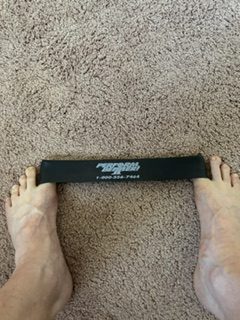
3) Consider wearing high-quality toe spacers part-time if your toes are squished together – best are these or these
4) Perform soft-tissue work on bottom of feet, adjacent to toe joints and whole arch area with a small diameter ball, like a Neuroball – see videos and footnote (5)
See Toe Joint Soft Tissue Work Video
Accordion title 1
This is a placeholder tab content. It is important to have the necessary information in the block, but at this stage, it is just a placeholder to help you visualise how the content is displayed. Feel free to edit this with your actual content.
Accordion title 2
This is a placeholder tab content. It is important to have the necessary information in the block, but at this stage, it is just a placeholder to help you visualise how the content is displayed. Feel free to edit this with your actual content.
See Arch Area Soft Tissue Work Video
5) Consider wearing minimalist-style shoes like those from Xero or VivoBarefoot (the most popular brands) a little at a time – build your wear-time up very gradually if your first time wearing minimalist shoes
6) Consider implementing what I cover below…
BIG TOE EXTENSION ABILITY
Lack of big toe extension (BTE) is common with OAs – BTE is the ability to move the top of toe upward toward instep/ankle. Lack of BTE limits propulsive ability and can create stress on plantar fascia (6) and other structures of foot/ankle and result in sub-optimal gait compensations. So, we need “enough” BTE to create propulsion during walking and it’s also required to work on strengthening your ankle plantar flexors (calves) as per last post, and is needed for all the exercises & drills I present here, so it’s the place to start. And, really, it’s advisable to work on it regularly even if you think you have “enough” BTE, as the trend with most OAs is to lose joint-tissue mobility as we age.
How to evaluate your current BTE ability:
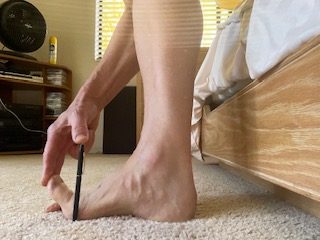
We need, rock bottom, at least 45 degrees of BTE for walking (more is better). You can see in the photo that the floor surface is 0 degrees and vertical pen is 90 degrees, so we need to be able to get our big toe at least half-way or more up to pen passively – you can use your hand to help. When evaluating, make sure your heel, little toe joint, and big toe joint are solidly on floor surface (this is referred to as the “foot tripod”) and you can let all your other toes follow your big toe upward into extension as well.
Working on gaining BTE:
Be gentle when moving into your current limit of BTE, just a slight feeling of discomfort when extending the limiting tissues, and then work on holding this position for at least 10-60 seconds, up to several minutes, as often as you can manage – at several days per week. There are many ways to work on BTE (7). Below are some accessible choices that I use with myself & my clients.
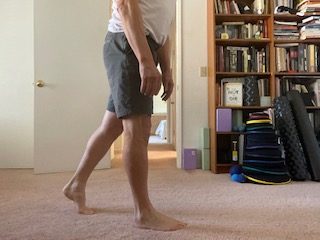
A) Stride stance: back foot is in BTE – see photo – use balance/stability aid if you need it
B) Facing wall in split stance: front foot is in BTE – see photo
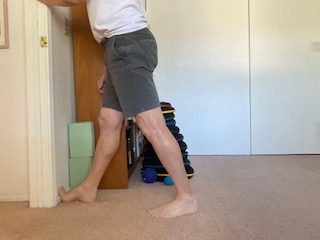
C) Combine BTE with ankle dorsiflexion (knee-shin comes toward wall) – see photo – yoga block is 4″ thick
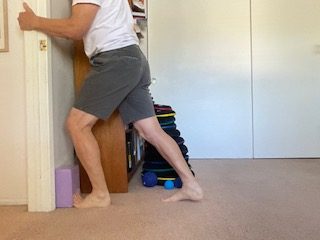
BIG TOE STRENGTH
We want to strengthen our big toes in the opposite direction of the ROM we’re trying to increase BTE above, which is big toe flexion strength (BTFS), or our ability to push into and against the ground with increased muscular force with big toe.
Besides being important for walking, some people suggest that BTFS is the number one predictor of falls risk in OAs; which is not a trivial suggestion considering the frequency & physical risks of falls for OAs. They site this study, as well as this study, to support; and there is also this study.
We can enhance BTFS using resisted isometric holds (no motion) or dynamic (movement) resistance exercises through a full or partial ROM. Below are some accessible choices:
(A) For isometric holds you can use “A” or “B” positions for BTE above, but start with less than maximal extension ROM – look to apply a sub-maximal muscular force into the wall or ground starting at 10 seconds and working up to 60 second holds, for 2-3 repetitions, several times a week.
(B) One of the most common BTFS exercises is the Vele forward lean maneuver. To perform, stand facing a wall about 6-10 inches away from you. Your hips/torso are parallel to the wall and your feet are straight-ahead – this is the start/finish position. Next, slowly lean forward with whole body (don’t bend at hips or waist). To stop the forward motion, push your toes down forcefully into the ground (heels solidly in contact with ground) and then return to the fully vertical position. Each forward lean should be held for 5-10 seconds and repeated for 5 to 20 repetitions for 1-3 sets and several times per week. Important: When pushing toes down into ground try NOT to “claw” your toes – try your best to keep your toes flat, NOT curved into the ground like a cat’s claw.
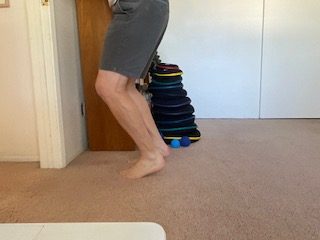
(C) Another BTFS isometric is “heel hovers” while pressing down into the ground with your big toe. Set up facing wall with knees bent and hands on wall, then lift your heels about 1” off the ground – see photo. Start with both feet on ground, then one foot, then one foot with resistance in one hand. Start by holding for 10 seconds, working up to 60 seconds, for 1-5 repetitions (less time, more reps if you’ve been at it a while), several times per week.
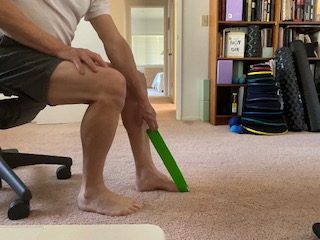
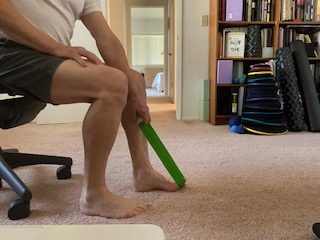
(D) If you have access to elastic resistance bands, use them to provide dynamic or isometric resistance as per photos – dynamic 8-15 repetitions with 1-3 repetitions-in-reserve, for 1 to 3 sets, several times per week.
SINGLE LEG BALANCE WALKING-RELATED FUNCTIONAL PROGRESSIONS
Single leg balance (SLB) is important for walking because about 40% of the gait cycle is spent on one leg. Also, SLB can be an entry point for toe, foot, ankle and side-of-hip muscle strengthening.
**For SLB, of course you need to be in a protected space where it’s not possible to fall – for example, like you’re facing out from a corner wall position with the high side of a chair directly in front of you, so you’re protected on all sides from a fall**
For SLB performance, your support foot should be straight-ahead, knee straight, and head/chin up with visual focus up & out, not down toward the ground. SLB positions should be held for at least 10 seconds moving toward 60 seconds, for 1-3 repetitions (less time, more reps), several days per week.
Single Leg Balance Progressions for walking:
A) “B” stance SLB (also called “rear kickstand”) – see photo – your non-support foot provides some additional balance assist as an entry point for working on SLB – keep heel up on non-support (B-stance foot)
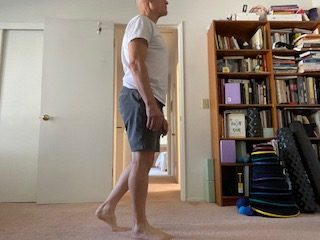
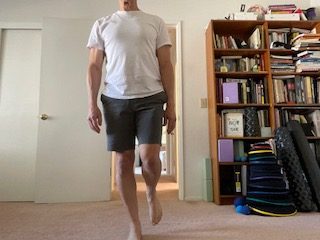
B) Conventional SLB – see photo – make sure your free leg does not touch your support leg and your arms don’t flail around (arms crossed at chest is best); if you lose balance, best to “tap” ground with your non-support foot to regain balance
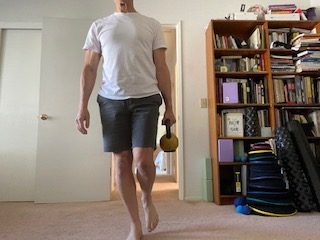
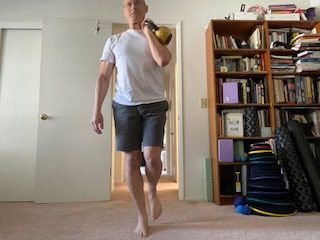
C) Conventional SLB with contralateral resistance at hip, then shoulder – see photos – this version of SLB increases strengthening stimulus for foot, ankle, side-of-hip & trunk
D) SLB using reciprocal arm & leg movements simulating walking pattern – see video – try to perform 5-15 repetitions per side. Start-finish position: Non-support leg (moving leg) and same-side arm in opposition – arm up and leg back
See SLB With Reciprocal Arm & Leg Motion Video
DYNAMIC ANKLE PLANTAR FLEXION PROPULSIVE POWER
These drills place you in a walking-related pattern while working on getting your heel off the ground more quickly than “normal” heel raise resistance exercises covered last post.
OAs lose power (ability to move quickly) sooner, and to a greater extent, than strength (ability to generate muscular force), so it’s important to translate strength gains into greater power production whenever possible – especially for vital activities like walking and sit-to-stands.
A) Heel-toe rocks – see video – try to maximize front heel lift while keeping knee straight – you can use a balance/stability aid like a pole or holding on to counter if needed for safety. Try to perform at least 5 repetitions on each side, working up to 15-20 each side. Note: I’m performing relatively slowly in video, but as you get better, you can try to perform the upward (heel lift) portion more dynamically.
See Dynamic Heel-to-Toe Rocks In Stride Stance Video
B) Contralateral heel & knee lift – see video – of course this drill requires as a prerequisite that you can perform body weight single leg heel raises already. Try to perform at least 5 repetitions on each side, working up to 15-20 each side – start slower and then gradually build up to do them as dynamically as you can.
View Contralateral Heel & Knee Lift Video
KEEPING YOU SAFE WHILE WALKING
Forward Rescue Step:
Everyone who walks is going to trip at some point and start falling forward – this is a fact of walking life – but whether you land on wrists, elbows, knees or face plant on the ground may depend on your ability to perform what I call a “forward rescue step (or steps)”.
The idea is that you practice aggressively & quickly moving your leg forward to catch and stop your forward fall. This maneuver requires a combination of leg power (moving leg quickly forward) and leg strength (stop the forward momentum of trip). The faster you are walking, the more steps it may require to stay on your feet – one step may not be enough – while walking downhill, I’ve taken as many as 3 consecutive forward rescues steps to save myself from a forward fall after tripping on a raised edge of sidewalk. Get good at forward rescue steps!!
See Forward Rescue Steps Video
You would progress rescue steps with:
1. First the speed moving leg forward
2. Then length of stride – aggressively take lengthy & fast step forward
3. Third, elevate up on toes (heel raise) before stepping which increases forward momentum
See Forward Rescue Step Starting From Heel Raise Video
Walking footwear thoughts:
It’s tricky now days choosing actual dedicated walking shoes – most people use running shoes and repurpose them as walking shoes. Commonly available running shoes are often “big-as-a-boat” with extreme amounts of stack height (height off the ground of footbed), substantial heel-to-toe drop (difference in heel-to-toe stack height), and an extreme upwardly curved toe rocker (8). This style of walking shoe seems to be fairly often recommended to OAs by many podiatrists. Walking shoe wise, I don’t know what’s exactly right for you as an individual, but I’d take the information below and give to your podiatrist and see what they have to say relative to your particular physical & foot situation.
Stack height is “built” by foam material that “cushions” feet on an unstable platform a couple of inches off the ground, which impairs proprioception, one of our vital physiological balance systems (9). And, the radical upwardly curved toe rocker (4) largely takes the big toes out of the picture and allows them to potentially weaken & stiffen. In addition, a large heel-to-toe drop thrusts the body forward (like high heels) which challenges balance, makes it more difficult to fully straighten the knees (terminal knee extension), and places more stress on the anterior knees while encouraging the calf/Achilles tendon to accommodate to a shortened position over time.
OAs using these commonly available running shoes on a limited basis for fitness walking is problematic enough (in my mind), but many OAs use them as their primary daily-use shoes for all activities, at all times – yikes.
So, what do I chose for fitness walking? I currently use the Altra Escalante 4 for fitness jogging & walking, which has 22-24 millimeters of stack height (just less than 1”), zero heel-to-toe drop, and a very wide, comfortable, roomy toe box (10). Are the Escalante’s optimal for fitness walking? They are not – I just don’t need an inch of cushioning for fitness walking, I’d prefer half that amount or less, and I’d prefer a minimal toe rocker & a less rigid sole at the forefoot/toe rocker – but the Escalante’s are just about right for jogging (their intended purpose).
For working with clients, normal getting around, and task-specific daily walking, I use the Xero Nexus Knit, which is an attractive minimalist shoe with very little stack height, zero heel-to-toe drop, a very wide, roomy toe box, and very flexible/bendable sole (all these attributes are the quintessential definition of a “minimalist” shoe). But if you’ve never worn a minimalist shoe and decide to try them, start with just a little daily time and very gradually add time as you adapt to them. And they may not be right for every OA at any particular point in their foot, toe & ankle health. For example, I regularly work on BTE, BTFS, ankle dorsiflexion ROM and ankle heel raise strength and have worn toe spacers at various times.
Footnotes:
(1) Walking ability is essential for older adults (OAs) to maintain independence; it is also the entry point for a physically active lifestyle; and walking has documented health & longevity benefits starting with modest daily step counts. But walking gets more challenging with age and walking gait characteristics change significantly with age compared to our younger selves, due in part to age-associated losses in strength, power or joint/tissue range-of-motion (ROM), as well as other functional deficits which we can improve with focused training.
(2) Everyone has seen the common age-related walking changes: gait speed slows down; stride length decreases; gait becomes less fluid and more rigid; feet clear the ground with less space and may even shuffle; vertical postural alignment becomes less vertical with the trunk leaning forward from hips/spine.
(3) Drills where you practice actual walking skills – gait enhancement drills – are important to improve walking ability, but you have to ensure safety if there’s a falls risk. There’s over a dozen gait enhancement drills I might work on with my clients, but if there’s any falls risk, I keep my hand(s) on a multi-handled gait belt around their waist to prevent a fall.
(4) This kind of shoe is advised if you can’t get any big toe motion (hallux rigidus) because of severe arthritis or other issues, but not advised if you wish to maintain and enhance foot & toe functional ability and ROM.
(5) Use a small-diameter ball, like a Neuroball and start in standing (with balance support) and roll ball very slowly over areas with light/moderate pressure. Your goal is to identify sensitive tissue; once you find a sensitive spot, maintain ball pressure on it for 15-60 seconds or until sensitivity deceases.
(6) Google “windlass mechanism”.
(7) See how a physical therapist thinks about it here in a short video by a local PT Tom Walters, who has 1.7 million IG follows and has written a great book on self-rehab, Rehab Science.
(8) The Hoka Clifton 10, an extremely popular “walking shoe”, has 1.7” & 1.3” of stack height at the heel & toe, respectively – nearly 2” off ground at the heel.
(9) Walking doesn’t require much impact cushioning because ground reaction forces are so much less than running – and wouldn’t many of us, if not most OAs, like to have a bit of mechanical impact stress with walking for bone health anyway?
(10) There’s “no free lunch” here – if you have Achilles issues then you may be better off with some heel-to-toe drop, but with a bit more anterior knee stress potential; if you have anterior knee discomfort, you may feel better with zero drop shoes, but with a bit more potential stress on Achilles; this is especially true if you don’t have enough ankle dorsiflexion ROM ability (the ability to move the top of your foot toward your shin – the opposite movement from pointing your toes.

Related Posts